We may receive a fee from trusted installers when you request a quote, or a commission when you buy through links on our site. This helps us keep our content independent, well-researched and up to date – Learn more
- Nusku is waiting for the patent to come through, with a UK launch expected in 2027
- The system aims to remove many heat pump barriers, including the need to replace radiators
- We think this is a great move for homeowners to invest in renewable energy and save valuable storage space
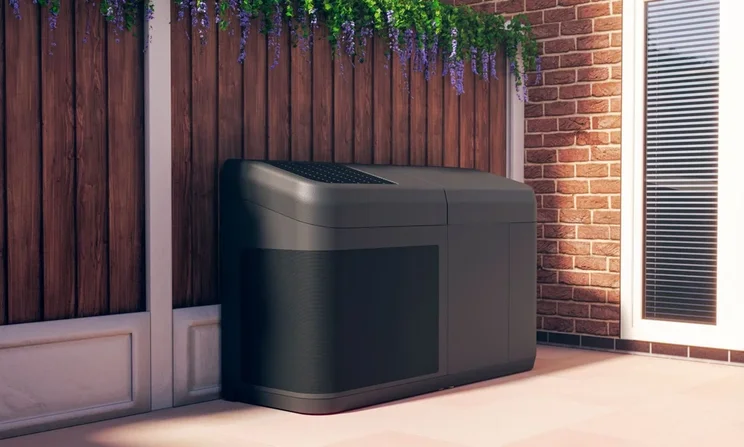
Nusku has unveiled a new heat pump that can be installed in a few days instead of a week, something that could help people replace broken down boilers more easily.
The patent-pending technology combines a water cylinder with a heat pump in one unit and is designed to sit outside the home, saving space and making installation simple. It’s set to be the only heat system of its kind in the UK and will be available in 2027.
The company said the heat pump is able to deliver high-temperature heat, which means you don’t need to replace your radiators. This potentially cuts installation down by several days. It currently takes around a week or more to install a heat pump. Nusku says its system takes only a few days to install.
Russell Murchie, CEO and co-founder of Nusku, said the goal of the system was to remove many barriers to installation as possible. These include finding space for a water cylinder, installing new radiators and potential noise from the heat pumps, as well misconceptions around cost and performance.
“Our design overcomes all these issues, which will make it quicker and easier for people to replace their gas boilers and switch to renewable energy with a heat pump that meets all their needs,” he said.
Murchie said that not only will it be cheaper to install than a traditional heat pump, but it will also be quicker, taking only take a few days than more than a week.
The system will target two and three-bedroom homes and support the government’s target of installing 600,000 heat pumps per year by 2030.
New prototypes are being trialed in homes across Bristol, with more widespread trials due to start in other cities before an official launch in 2027.
Boiler Upgrade Scheme gets added boost
If your home is heated by oil or liquid petroleum gas (LPG), you can now get £9,000 towards a heat pump as part of the Boiler Upgrade Scheme.
The behind this is to help households hit hardest by the US-Iran war and is the government’s latest effort to get people off gas and onto electricity.
We think this is a great move by the government, and even though we won’t see the actual impact on bills straight away, it helps get households away from fossil fuels and onto renewable energy.
If you don’t have these in your home, you might still qualify for £7,500 off the cost of an air-source or ground-source heat pump, or £5,000 of the cost of a biomass boiler. If you qualify, you could be paying as little as £500 for the rest of the heat pump.
The BUS works on a first-come, first-served basis. Your installer will apply on your behalf and remove the amount from the cost of the heat pump installation.
To be eligible, you must meet these requirements:
- You must own the property you’re applying for, including if it’s a business, a second home, or a property you rent out to tenants
- You must be replacing fossil fuel heating systems, such as oil or gas
- You must have a valid EPC certificate
You can get the BUS grant for a biomass boiler if you meet all these requirements:
- Your property is off the gas grid
- Your property is in a rural location
- Your boiler has an emissions certificate showing that polluting emissions are kept to a minimum
The BUS is not available to properties that have already received public funding for a heat pump or biomass boiler in the past, through schemes like the now defunct Energy Company Obligation scheme.
Properties considered to be social housing under the Housing and Regeneration Act 2008 are also not eligible.
New builds are also not eligible, unless they have been completed with a fossil fuel boiler.