We may receive a fee from trusted installers when you request a quote, or a commission when you buy through links on our site. This helps us keep our content independent, well-researched and up to date – Learn more
- Who invented the solar panel?
- How is solar energy measured?
- What are solar panels and how do they work?
- What is a solar inverter and how does it work?
- What is a solar storage battery and how does it work?
- The National Grid
- What is a solar diverter and how does it work?
- How can I control how my solar energy is used?
- Where does electricity go once it’s used?
- Glossary
- Solar energy is sunlight that has been converted into electricity
- The planet receives enough sunlight in one hour to power the world for an entire year
- The Eco Experts are here to make the science behind solar energy as understandable as possible
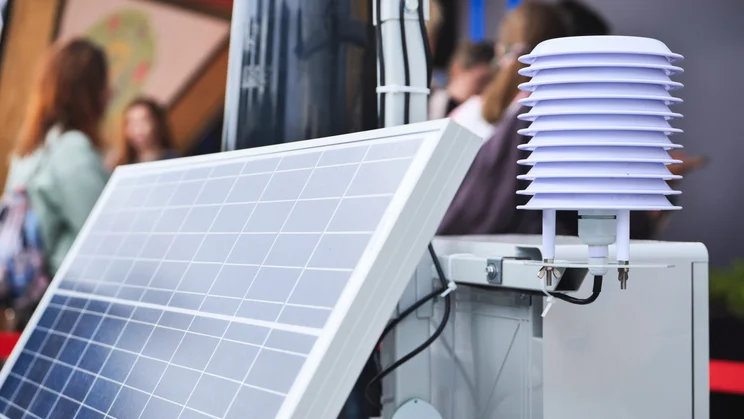
We spend a lot of time writing and talking about the benefits of solar panels, but the what is solar energy and how does it work?
Solar energy is the process of converting sunlight into electricity. In simple terms, it’s when we capture sunlight by using solar panels, which are made up of silicon solar cells. This creates something called an electric charge, which builds up into a flow of electricity.
Sounds simple enough, right?
But the actual science behind it is more complicated. Let’s start at the beginning.
Who invented the solar panel?
This is a great question because it doesn’t have a simple answer. The photovoltaic effect, which we go into later, was discovered by French physicist Edmond Becquerel in 1839 (when he was just 19).
Later, American inventor Charles Fritts built what is largely recognised as the world’s first solar panel in 1883. It only had an efficiency rate of 1-2%, miles below today’s average of 18-23%, but he was still able to turn the science of solar power into useable energy, fitting it to a roof in New York City.
Much later, the first silicon solar cell was invented in 1954 by a company called Bell Labs. Now, solar panels are used to power residential and commercial properties, and in the year 2000 were installed on the International Space Station (ISS). That’s a pretty big leap in solar advancement in the space of 46 years.
When humanity eventually returns to the Moon, solar energy will play a big role in helping NASA build a working station up there.
The energy bill crisis is pushing demand for solar panels to levels we haven’t seen before. That’s why we’ve made this guide to explain how it all works. For more details on solar panel costs or what grants there are for solar panels, read our dedicated pages.
How is solar energy measured?
- Electricity is measured in Amps (A) and refers to the rate of power usage
- Energy is measured in Kilowatt-hours (kWh) and shows the amount of power consumed over a specific duration
- Power is measured in Watts (W) or Kilowatts (kW) and indicates how fast energy is being consumed in a single instance
Electricity meters calculate the total energy consumed in a household using this equation:
Energy (kWh) = Power (kW) x Time (hours)
What are solar panels and how do they work?
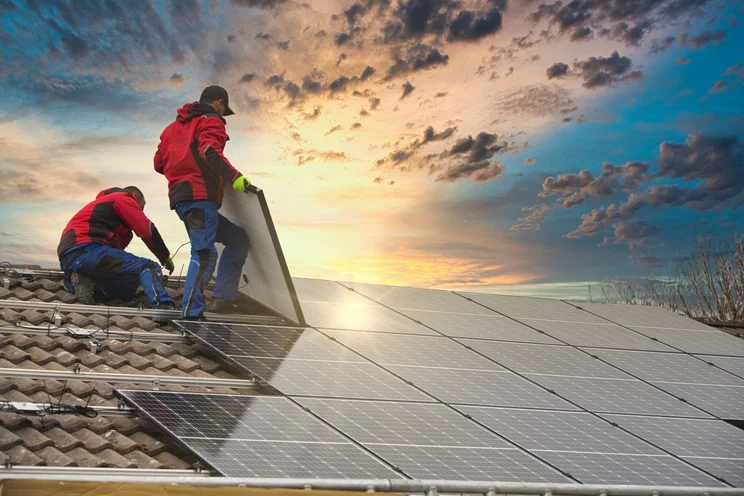
Solar panels are made from silicon, which is something called a semiconductor. A semiconductor is a material that can both conduct electricity and act as an insulator against it. This means it can let electricity pass through it or stop it.
Like everything else in the world, semiconductor materials such as silicon, are made up of atoms. An atom is made up of a proton and an electron which orbit around something called a nucleus (also called the ‘centre’). With semiconductor materials, the electrons aren’t held to the nucleus of their atoms very tightly.
That’s the material of a solar panel, but what about light? In simple terms, light is a stream of particles called photons. If these photons have enough energy, they transfer their energy to an electron (one part of an atom), breaking the bond with the nucleus. This is why solar panels are most effective in bright sunshine, because the photons are the most energised.
When light hits the silicon, this is exactly what happens. The electrons break free from the atoms, a process known as the photovoltaic (PV) effect – and become something called an electric current. This is why you might see solar panels sometimes called ‘PV systems’.
On average, solar panels convert 18-23% of the available energy from sunlight into usable electricity.
This electricity travels from the solar panel through a wire, and to a solar inverter.
What is a solar inverter and how does it work?
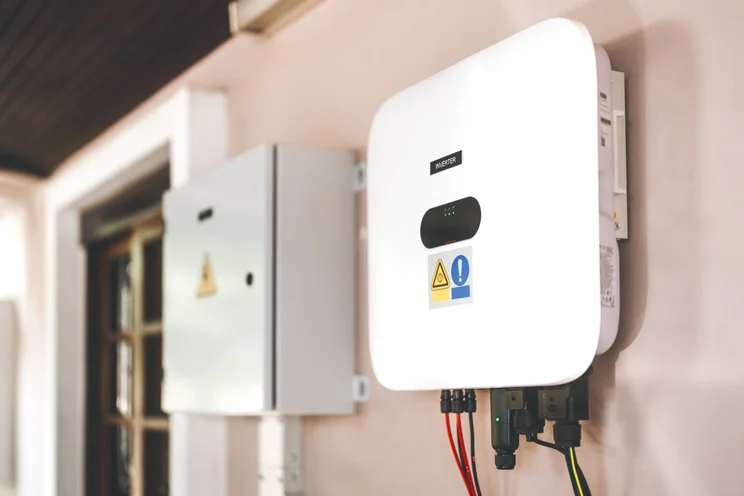
What does a solar inverter do? The job of a solar inverter is to convert the electric current from a direct current (DC) to an alternating current (AC).
The difference between AC and DC is:
- DC – the electricity charge flows in one direction, maintaining steady polarity and a frequency of 0 hertz (HZ), meaning it keeps a steady voltage over time
- AC – the electric current rapidly changes between a positive and negative charge, causing it to switch direction 50-60 times per second
The reason PV cells produce DC electricity is because the semiconductor (the silicon material) has an internal electric field which forces the electric current to flow in one direction.
It does this because the constant voltage creates a static, one way field that pushes the charged electrons from negative to positive terminals.
Solar energy generated by a solar panel has to be converted to AC. Why? Because the National Grid is only designed for AC electricity and so are most household appliances.
This is because the voltage of AC can be converted easily and more efficiently than DC, minimising power loss over long-distance power transmission.
Converting AC to DC is done using something called a transformer.
When it comes to solar energy, there are two types of solar inverter:
- Hybrid – Handles solar panels and battery storage
- AC-coupled – Connects a battery to a pre-installed solar system
After being converted by a solar inverter, all AC power goes to your household’s fuse box via a dedicated circuit breaker and AC cable. This is where it is shared around your home.
Your fuse box acts as a central control. The electricity is split into separate circuits, providing power for household appliances, lighting, sockets and other low-carbon technology such as heat pumps and electric vehicle (EV) chargers.
Each circuit is protected by a fuse, designed to burn when overloaded, safely stopping the power.
Excess energy is delivered to one of two places. A solar storage battery, or the national grid.
What is a solar storage battery and how does it work?
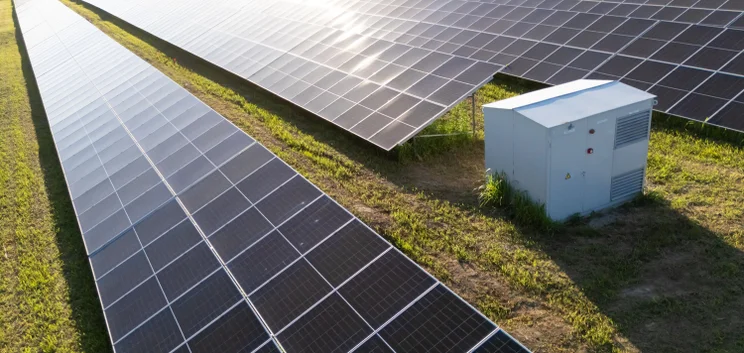
A solar storage battery does exactly what you’d expect it to do. It stores the excess electricity generated from your solar panels, so that you can use it whenever you need.
There are two types of storage setup:
- DC-Coupled – the battery connects between the solar panel and inverter before conversion, making it more efficient
- AC-Coupled – the battery connects to the existing AC circuit and reverts the current to DC, making it ideal for retrofitting
Most storage batteries use lithium-ion technology to store solar energy. It uses something called electrodes to control how and when and your solar energy is used.
An electrode is an electrical conductor which acts as a bridge to connect to a non-metallic part of a circuit. Inside the solar storage battery, they are referred to as anode and cathode.
The storage battery connects to your household electricity by using something called ‘current collectors’ (a conductive material that allows electrons to travel in and out of a battery). When the solar panel feeds electricity into the charging mechanism inside the storage battery, positively charged lithium ions are driven out of the cathode, and use an electrolyte to move from the to the anode where they are stored, in a process known as intercalation.
- Cathode – Made of a lithium-based metal oxide, it is the source of lithium ions and measures the battery’s overall capacity and performance
- Anode – Usually made of graphite, it stores the lithium atoms while charging
- Electrolyte – A medium that lets ions flow between the anode and cathode, typically Lithium hexafluorophosphate (LiPF6)
During discharging, the ions return to the cathode, which releases the electrons through an external circuit. These electrons leave the storage battery and are converted back to AC electricity to power devices:
- Charging – Lithium ions travel to the anode via electrolytes and store energy as chemical potential
- Discharging – Ions move back to the cathode, and the charged electrons create electricity
A separator keeps the anode and cathode apart safely – if they were to touch each other, the battery would short circuit.
The National Grid
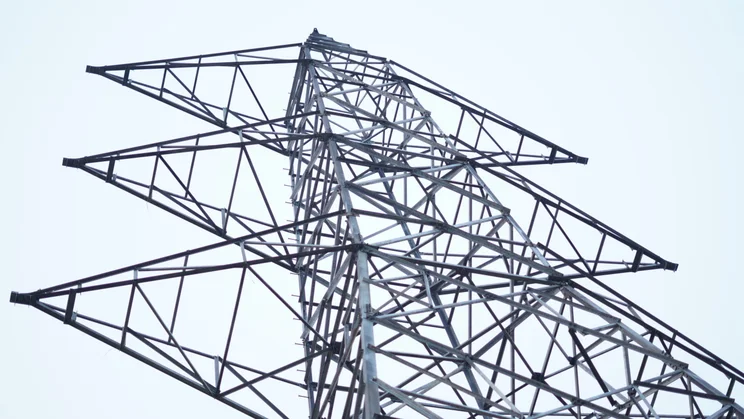
The other option for your electricity is for it to go to the national grid. Through the Smart Export Guarantee (SEG), you can not only save money on your energy bills but make money on the energy you don’t use. But how does it get there?
The process is pretty simple. Any surplus power that goes through your fusebox, either directly from the solar inverter or from the storage battery passes through something called a ‘bi-directional meter’ (an advanced energy meter that measures flowing in two directions). This records how much energy you import from the grid and any you sell back to the grid. The energy you don’t use and that you sell back to the grid goes to your local distribution network, which is managed by a Distribution Network Operator (DNO).
A DNO is a private company licensed to own and operate local electricity cables and towers.
From there, the energy you’ve sold will travel through underground cables or overhead wires to the wider national grid where it will go to other households.
But how do these cables and wires that move electricity all over the country work? They’re made of a conductive material, almost always copper. The electrons don’t travel individually from start to finish. Instead, the voltage acts like a pump, causing electrons to push neighbouring electrons onwards in a domino effect.
To keep people safe from the high voltages, which in some extreme cases can reach 765,000 volts, steel lattice pylons support the overhead cables.
When your electricity is turned off, the electrons stop moving and stick to the atoms they were closest to at that moment.
What is a solar diverter and how does it work?
Solar diverters automatically shift unused energy to another appliance instead of sending it to the National Grid. You don’t have to have one in your solar panel system, but they can cut your bills much faster because they let you use your unused electricity to heat your water.
A solar diverter uses current transformer (CT) clamps which are physically attached to the main incoming power cable to monitor the flow of electricity between the solar PV system and the grid.
The sensor can detect power flowing out of the house to the grid as surplus, and will also compare solar generation against household consumption to determine when generation exceeds demand.
If you have solar storage batteries, a solar diverter will often only start operating after the batteries are filled.
Something very important to remember: your diverter will not work in a blackout. If you want to make sure your solar panel system works in a blackout, you’ll need something called a hybrid solar inverter.
How can I control how my solar energy is used?
It is up to you how much solar power you use, store and sell. However you choose to use your solar energy, a smart meter will help you make the right choice every time.
Smart meters monitor your electricity consumption in real time, using sensors to measure 4,000 – 16,000 samples per second of electrical current flow and voltage at high frequencies.
A microprocessor then calculates the instantaneous power to give energy readings in kilowatt-hours (kWh).
Where does electricity go once it’s used?
Electricity isn’t a tangible thing, and therefore it doesn’t physically go anywhere after it’s used. Instead, it’s converted into other forms of energy, such as heat, light or sound. This is why when you use an electrical appliance such as a laptop, it can sometimes feel warm to touch.
Almost all electrical energy dissipates as heat eventually.
Glossary
- AC electricity – electricity where the electric charge periodically reverses direction
- AC-coupled inverter – connects a battery to a pre-installed solar system
- AC-coupled storage battery – connects to the existing AC circuit and reverts the current to DC
- Amps – the rate of power usage
- Anode – the electrode where electrons are released
- Cathode – the electrode where electricity leaves or electrons enter
- Charging – lithium ions travel to the anode and store energy as chemical potential
- Current collector – a conductive material that allows electrons to travel in and out of a battery
- Current transformer clamp – a sensor that measures how much electricity flows through a wire
- DC electricity – electricity that flows steadily in only one direction
- DC-coupled battery – connects between the solar panel and inverter before conversion
- Discharging – ions travel to the cathode and the charged electrons create electricity
- Electrolyte – a medium that lets ions flow between electrodes
- Electron – a negatively charged particle that orbits the centre of an atom
- Hybrid inverter – handles solar panels and battery storage
- Kilowatt-hours – the amount of power consumed over a specific time period
- Lithium ion battery – an energy storage device that moves lithium ions between electrodes
- Photons – particles of light
- Photovoltaic Effect – the process of converting light into electricity
- Semiconductor – Material that acts as a conductor and insulator
- Watt/ kilowatt –how fast energy is being consumed in a single moment
- Voltage – the electrical pressure that forces electrons through a circuit