


We may receive a fee from trusted installers when you request a quote, or a commission when you buy through links on our site. This helps us keep our content independent, well-researched and up to date – Learn more
- Oil and gas from the North sea will not make energy cheaper
- Fossil fuels from the North Sea are almost all gone
- Renewables are cheaper, cleaner, and more reliable
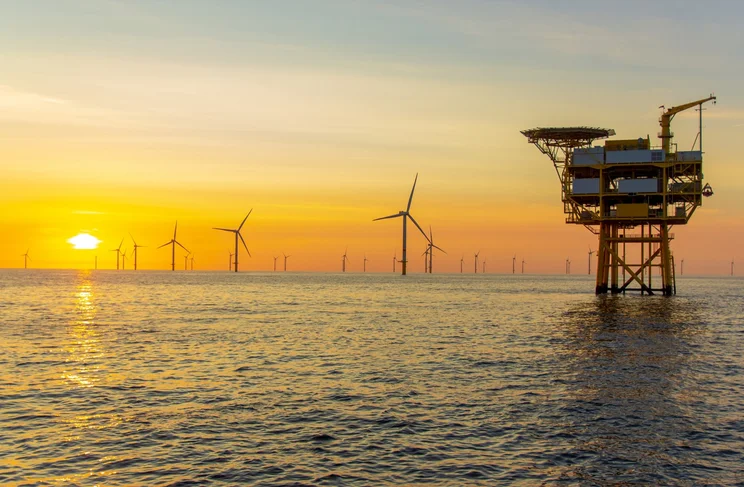
Drilling in the North Sea for oil, and even taking every last drop of it out, will not make bills cheaper, despite what Reform UK and clean energy sceptics would like us all to believe.
There is no doubt that the UK relies too much on importing energy and while drilling for oil 12 miles off the coast of Scotland might sound like an easy answer, it is the wrong answer.
Why? Because it would do nothing to stop bills jumping with every major foreign policy crisis. That is why the government has rightly banned new North Sea oil licenses because only renewables can make the UK energy independent in the long run.
Despite the benefits of clean energy over fossil fuels, Richard Tice from Reform UK says his party would ‘extract every drop’ of North Sea oil. It’s at best simplistic, at worst, a cynical effort to score points off a government that has been caught off guard by huge spikes in the price of energy.
Prime Minister Andy Burnham is being pressured to approve the Rosebank and Jackdaw sites by none other than US president and fossil fuel superfan Donald Trump. Burnham has refused to rule out approving Rosebank and Jackdaw and instead said he will take a “pragmatic approach” to the North Sea.
If it sounds like he’s setting us up for drilling then that’s exactly what he’s doing. The problem is that drilling in the North Sea is not the pragmatic response for the simple fact it would generate next to no money for the state and not cut bills at all.
Rosebank, for instance, would potentially cost the government £258mn while making its private developers Equinor and Ithaca Energy £1.5bn in profit. This is because of the UK’s tax structure. Essentially, a huge bulk of the profits will be made after the windfall tax (called the Energy Profits Levy) is scrapped in 2030.
Quite simply, the North Sea is not the answer to any of our energy problems because:
- There isn’t enough oil left there to make much of a difference fuel costs
- Relying on North Sea oil would do nothing to stop household energy bills ballooning as we’d still be at the mercy of global markets
- The UK’s oil refineries simply aren’t up to task, as they’re too old and not suited to processing the type of oil in the North Sea
- About 80% of North Sea oil gets sold abroad, meaning UK households don’t see any of it
Let’s go into some of these in more detail.
The North Sea is a mature basin
Most of the North Sea oil and gas is gone. In fact, between 90-94% of the North Sea’s total oil reserves have already been extracted. That’s not Greenpeace talking, that’s from the UK government and North Sea Transition Authority (NSTA).
The NSTA says there are about 2.9 billion barrels of oil equivalent (BOE) left in the North Sea. What does this mean for homeowners? Not much, because it while it would create 2,500 terawatt-hours (TWh) of energy, and while that might sound like a lot (one TWh = one million megawatt-hours and one billion kilowatt-hours), it wouldn’t all go to heating homes and would also be used for transportation and industry.
In 2023, the UK used about 1,506 of TWh in total, meaning that 2,500 TWh would provide enough energy for about 18 months, and that’s being optimistic. There is energy to be had, and it could possibly be a very short-term fix, but what happens when the oil and gas runs out?
The North Sea doesn’t produce oil and gas enough to bring bills down
The UK accounts for just 0.11% of the world’s global gas reserves and 0.08% of the world’s oil reserves, with the North Sea accounting for most of these tiny proportions. Even if the UK were to extract all of its oil and gas from the North Sea and elsewhere (there is gas in the UK Continental Shelf of the Irish Sea), we’d still lean heavily on imported liquified natural gas (LNG).
The near empty reserves of the North Sea mean the UK is what is called a ‘price taker’ rather than a ‘price maker’ because its reserves aren’t big enough to change the international market value. In effect, the UK has no market power despite the North Sea and this will never change.
If the government were to extract all of its gas and oil from the North Sea, two things would happen: firstly, when it runs out of oil and gas, it will have to import yet more of it, and secondly, the fuel it gets would barely make a dent in energy bills.
It’s estimated that in that scenario (where the North Sea is emptied of its oil and gas), household energy bills would fall from about £16-£82 a year. By contrast, they would fall by £105-£441 with renewable energy and electrification.
It’s too expensive and the UK doesn’t have the right infrastructure
Believe it or not, the UK sells about 80% of the oil it takes out of the North Sea because the industry is completely privatised and we don’t have the right refineries. All of the oil and gas taken from the North Sea is owned by private companies who then sell to the highest bidder on the open market. Unlike in other countries, where there would be a national oil or gas company to supply homes, the goods get sold by Shell, BP, or someone else.
Another reason is that all four of the refineries in the UK were built before North Sea oil was discovered. North Sea oil is very high in sulphur, which our refineries can’t deal with. That means the oil that most of the North Sea oil that does get used has to be sold to another refinery abroad, usually in the Netherlands, and then bought back. This makes North Sea oil an expensive option that is destined to run out very quickly.
According to analysis from the Cleantech for UK, it could take 20 years to improve the UK’s infrastructure to extract all of the remaining oil and gas from the North Sea. If remember what we said earlier, there would be only just under two years of electricity. Two decades of work for less than roughly 18 months of energy. How much would it cut energy imports by? According to Cleantech for UK, a mere 2%. Simply put, the North Sea is bad for British billpayers.
Why renewable energy is best
Renewable energy is cheaper and is the only way to make the UK energy independent. As the US-Iran war, and the chaos in the Strait of Hormuz, has shown us, the UK remains horrifically vulnerable to international markets.
“True energy security today means reducing exposure to volatile global fossil fuel markets, not deepening it,” says Laura Anderson, senior associate at the Energy and Climate Intelligence Unit (ECIU).
“The price shocks of recent years have shown how reliant the UK is on international gas markets, leaving households and businesses vulnerable to geopolitical events and decisions taken by actors like Putin and Trump,” she continues.
“Expanding domestic renewables, by contrast, offers a way to generate stable, homegrown energy that isn’t subject to those same external pressures.”
The UK is already producing more renewable energy, and throughout the US-Iran war this saved billpayers about £7m a day, with wind and solar providing 40% of the country’s electricity demand as generation increased by 52% on the last crisis in 2021.
The North Sea looks like a straightforward option, but it would not be the right one. Only renewables can protect billpayers and households.


