

We may receive a fee from trusted installers when you request a quote, or a commission when you buy through links on our site. This helps us keep our content independent, well-researched and up to date – Learn more
- A metal complex, known as ‘spin-flip,’ reached 130% energy conversion efficiency
- Energy conversion efficiency has previously been limited to 100%
- Spin-flip has the potential to be used for higher-performance solar cells
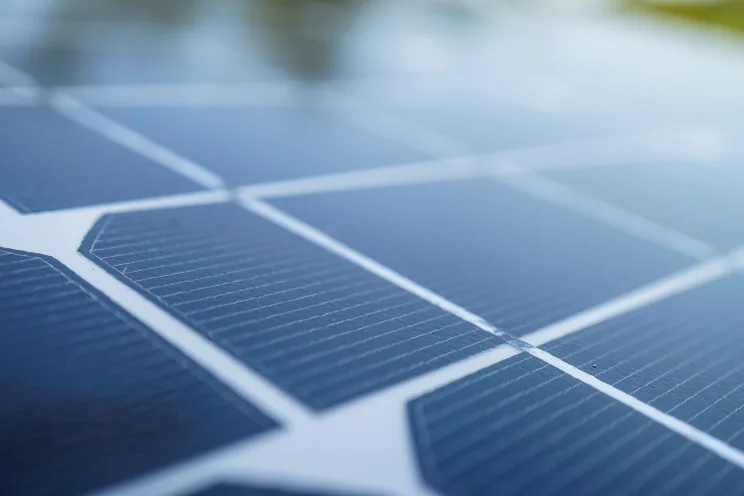
Scientists in Japan have found a way that could help solar panels bring energy bills down to £0 by increasing their efficiency to 130%, and raised the possibility of improving the aver 22%.
The researchers from Kyushu University in Japan and Johannes Gutenberg University (JGU) Mainz in Germany did this by using a process called ‘singlet fission’ and a new metal complex known as a ‘spin-flip’ emitter.
How have they made solar panel material with 130% efficiency?
In a normal solar panel, one electron is made every time it is hit by one particle of light (also called a photon). This creates one unit of electricity.
The scientists used a material called tetracene to do something called ‘singlet fission’, which splits the photon into two lower-energy particles (which are called ‘excitables’).
In simple terms, this means for one photon/particle of light, a solar panel can now generate two electrons rather than one, and that means it creates two units of electricity when otherwise it would only create one.
That’s where the ‘spin-flip’ comes in because it traps the extra particles created by the solar panels, meaning a solar cell can actually generate more units of electricity than the number of photons that’s absorbing.
This could potentially have huge benefits for household energy bills because most solar panels only generate units of electricity from one-third of the photons they absorb.
The researchers said the next steps are to convert the liquid solution used here into a solid form that can be fitted to a solar panel, reliably and effectively and take the super-efficient solar panel to market.
The Eco Experts says:
We think that solar panels are incredibly important when it comes to supplying clean, home-grown electricity to the UK. Not only does it reduce our fossil fuel dependence at a time like this where fuel is becoming increasingly expensive, but it can also help reduce our energy bills.
Solar panels are also an important part of addressing climate change and the government’s goals of net zero emissions by 2050. But despite their importance, current solar cells capture only a fraction of the sun’s immense energy.
Breakthroughs such as the spin-flip are incredibly important for the future of solar energy, as the more efficient panels become, the more we can look forward to a cleaner future.
In our opinion, this is a really exciting time for homeowners as the opportunity to lower energy bills continues. The next challenge is to make sure that solar panels are as efficient as possible to reduce energy bills to practically nothing.


