We may receive a fee from trusted installers when you request a quote, or a commission when you buy through links on our site. This helps us keep our content independent, well-researched and up to date – Learn more
Government to support UK households who rely on heating oil
US-Iran conflict has caused prices to double
About 1.7 million households use heating oil
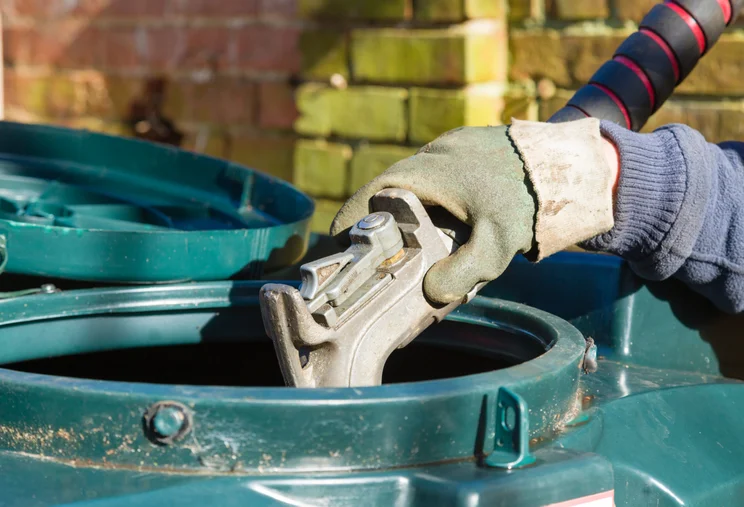
An oil tank being filled up outside a home. Credit: Adobe
Households that use heating oil will be offered help with their energy bills following huge price spikes caused by the ongoing US-Iran conflict.
In a press conference, Prime Minister Sir Keir Starmer said he was offering “immediate support for vulnerable heating oil customers, proving £53m for those households that are most exposed.”
He also said there will be legal action against any oil companies who have been found to be “jacking up prices” and cancelling orders in order to benefit from the chaos.
He also said that any savings that energy companies make as a result of government intervention should be passed onto to customers to help with household costs.
In total, he set out a five-point plan to help households and consumers, which includes maintaining the energy price cap until the end of June. Other changes included:
The fuel duty cap has been extended until September
The government will support rural communities with the cost of heating oil
The UK will be pushing ahead with its long-term plan to build Britain’s energy security (although no further details were given)
The government will continue to work towards a swift resolution of conflict in the Middle East. “Ending war is the quickest way to reduce cost of living,” Starmer said.
What is heating oil and how many households use it?
Roughly 1.7 million households in the UK use heating oil. In Northern Ireland it’s used by an estimated two-thirds of households.
It works by storing fuel in a tank, usually outside or in a garage, which then pumps it to a boiler. At that point it is then turned into heat in a combustion chamber and circulated around the home’s radiators.
It can be an efficient way of heating a home, but there are major disadvantages to it, the biggest being price volatility. The price of heating oil in the UK has more than doubled since the beginning of the US-Iran conflict on 28 February.
On 27 February, the day before bombing started, the price of heating oil was 60p a litre. As of 16 March, it is 128p (£1.28) a litre.
Written By
Maximilian SchwerdtfegerDeputy editor
Max joined The Eco Experts as content manager in February 2024 and became deputy editor in 2025. He has written about sustainability issues across numerous industries, including maritime, supply chain, finance, mining, and retail. He has also written extensively for consumer titles like City AM, The Morning Star, and The Daily Express.
He has represented The Eco Experts on national television several times, including the BBC’s Sunday Morning Live and ITV Tonight .
In 2020, he covered in detail the International Maritime Organisation’s (IMO) legislation on sulphur emissions and its effects on the global container shipping market as online editor of Port Technology International.
He also explored the initiatives major container ports and terminals have launched in order to ship vital goods across the world without polluting the environment.
Since then, he has reported heavily on the impact made by environmental, social, and governance (ESG) practices on the supply chain of minerals, with a particular focus on rare earth mining in Africa.
As part of this, in 2022 Max visited mines and ports in Angola to hone in on the challenges being faced by one of the world’s biggest producers of rare earth minerals.
His most recent sustainability-related work came much closer to home, as he investigated the eco-challenges faced by independent retailers in the UK, specifically looking at how they can cut emissions and continue to thrive.
Max lives in South London and is an avid reader of books on modern history. He has also recently learned to play the game Mahjong and takes every opportunity to do so. He is also yet to find a sport he doesn’t enjoy watching.
Tamara BirchNewsletters and sponsored content editor
Tamara is a journalist with more than six years experience writing about environmental topics. This includes advising small businesses on cost-effective ways tom become more sustainable, from installing to solar panels and heat pumps and reducing waste. She has used her journalist and research skills to become highly knowledgeable on sustainable initiatives, issues, and solutions to help consumers do their bit for the environment – all while reducing monthly costs. Now, she’s using this experience to advise homeowners on the benefits of installing low-carbon technologies. She is also qualified in offering innovative initiatives to improve sustainability practices in businesses, from advertising to marketing and publishing.
Her passion for sustainability and eco-friendly solutions stems from a long obsession with nature and animals and ensuring they feel looked after. In her free time, Tamara enjoys reading fantasy novels, visiting the gym, and going on long walks in new areas.
Ferrari’s first EV sells for £29mn
The first production model of the Ferrari Luce sold at auction for £29mn at an auction in California despite backlash.