We may receive a fee from trusted installers when you request a quote, or a commission when you buy through links on our site. This helps us keep our content independent, well-researched and up to date – Learn more
- The turbine blades are the largest UK manufactured blades, spanning further than a Premier League football pitch
- One revolution of the blade creates enough energy to brew almost 1,000 cups of tea
- The East Anglia THREE project will produce enough clean power for over 1.3 million households
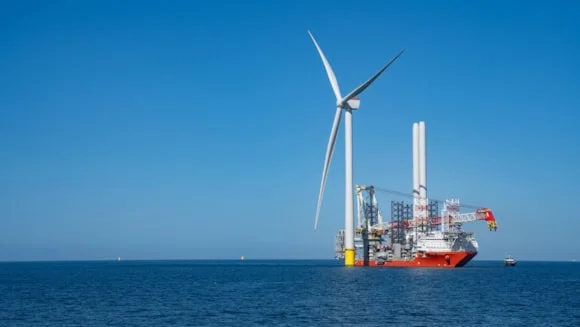
The East Anglia THREE (EA3) offshore wind farm has installed its first turbine and at the same time broken the record for the longest blades in the UK.
The turbine features three 115 metre blades, with each one spanning further than a Premier League football pitch.
There will be 285 record-breaking blades in total, for the 95 turbines that make up the EA3 offshore wind farm, which will sit 69km off the Suffolk coast. They are all being manufactured in the UK, at wind energy specialists Siemens Gamesa’s factory in Hull.
This project has been made possible by a partnership between integrated energy giant ScottishPower and UAE-owned renewable energy company Masdar.
Charlie Jordan, CEO of ScottishPower Renewables, called the record a “defining moment and a UK industry first for ScottishPower, Iberdrola and Masdar,” and said that they’re accelerating “the deployment of homegrown renewable energy at scale.”
“East Anglia THREE will be the biggest and most powerful offshore windfarm in our portfolio,” Jordan said.
“That means billions of pounds invested in UK and global supply chains; thousands of jobs supported during construction; more than a hundred long-term roles created in the East of England; and greater energy security, with more clean power coming on to the grid than ever before.”
During construction, over 2,300 jobs have been supported, with 100 permanent roles created.
Jordan continued: “East Anglia THREE will play a crucial role in the UK’s clean energy future and it’s fantastic to see our vision come to life.”
The 14megawatt (MW) turbines stand at 262m tall, which is higher than the observation deck at the shard, and have a rotor diameter of 236m.
The previous record was held by turbines also manufactured by Siemens Gamesa. They were seven metres shorter, coming in at 108m.
UK Head of Siemens Energy and Siemens Gamesa, Darren Davidson, said: “These are the biggest blades ever built for a project in UK waters – a real landmark for offshore wind.
“We’re proud that these record-breaking blades have been manufactured at our factory in Hull, where we now employ more than 1,400 people, and where we’re also investing in the future by training our next generation of workers through a well-established and successful apprenticeship scheme.”
Initial operation is targeted to be at the end of 2026. Once operational, a single revolution of just one of these giant turbines has massive energy saving potential. It could produce enough electricity for one of the following:
- Powering a UK household for over four days
- Charging 1,700 mobile phones
- Brewing nearly 1,000 cups of tea
- Drive an electric vehicle (EV) for 100 miles
EA3 will be amongst the world’s largest offshore wind farms once operational, delivering homegrown, renewable electricity with the equivalent of powering 1.3 million households across the UK.
Currently, the title for world’s largest wind turbine goes to the Chinese energy firm Dongfang Electric Corporation (DEC), who have commissioned the world’s largest single-capacity offshore wind turbine.
Husain Al Meer, Director of Global Offshore Wind at Masdar, said: “This is a milestone moment for the UK’s offshore wind sector, with the completion of the first turbine for East Anglia THREE representing a truly monumental achievement.
“We are proud to work alongside ScottishPower and Iberdrola to bring this project to fruition and to be playing our part in securing the UK’s clean energy future, while helping to create jobs and drive sustainable growth.
“We see tremendous potential for offshore wind, not just in the UK but across the wider European market, where offshore wind can provide critical energy security, power economic progress and help nations achieve their clean energy objectives.”