

We may receive a fee from trusted installers when you request a quote, or a commission when you buy through links on our site. This helps us keep our content independent, well-researched and up to date – Learn more
- Efficiency for an opaque 60-nanometre perovskite cell has reached 12%
- Perovskite solar cells are approximately 10,000 times thinner than a human hair
- They enable energy conversion on surfaces where traditional solar panels are impractical
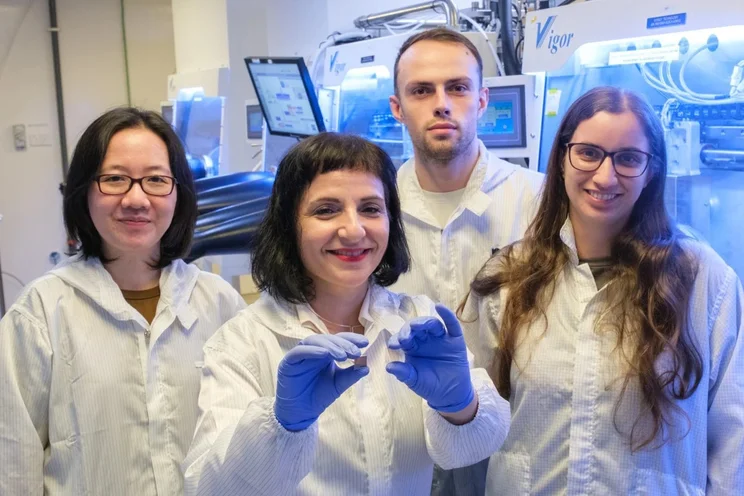
Buildings could soon be used to generate clean energy thanks to a new type of ultrathin solar cell that can be placed into windows.
The discovery, made by scientists from the Nanyang Technological University (NTU) of Singapore, paves the way to a future where an electric vehicle (EV) can charge via its sunroof while parked under the sun, or wearable devices such as smart glasses or watches can use sunlight to charge via minute solar panel cells.
Led by Associate Professor Annalisa Bruno, the researchers created a perovskite (PV) solar cell 50 times thinner than conventional PV cells. To put it in perspective, that’s around 10,000 times thinner than a strand of human hair.
The semi-transparent PV solar cells recorded 7.6% efficiency, meaning it converted 7.6% of the sunlight it absorbed into electricity. The opaque cells recorded efficiency levels as high as 12%.
The cells’ power to generate renewable energy while allowing natural light to pass through means they can be used in a lot of different areas, such as buildings, industrial areas or vehicles.
One of the researchers, Dr Luke White, said it “opens up new possibilities for sustainable architecture, such as tinted windows that generate electricity.”
As well as the fact they can be used on-the-go (in the sunroof of an EV, for instance), the solar cells are also colour-neutral and transparent enough to be put onto windows and building fronts without significant aesthetic changes.
Associate Professor Bruno, Cluster Director for renewables, low-carbon solutions and energy storage, who conducted the experiments at the Energy Research Institute, explained that “the built environment accounts for roughly 40% of global energy consumption, so technologies that seamlessly convert buildings’ surfaces into power-generating assets are gaining urgency.”
She added that the “perovskite solar cells offer distinct advantages as they can be manufactured using simple processes at relatively low temperatures.
“They can also be tuned to absorb specific wavelengths while remaining transparent, and could potentially be scaled over large areas, reducing their carbon footprint.”
In contrast to traditional silicon solar technology, these perovskite-based cells can harvest energy from diffused or indirect light. This makes them particularly effective for cities, where cloud cover and vertical architecture often restricts direct sunlight.
Should the technology be expanded at its current efficiency, buildings with expansive glass exteriors could be repurposed as functional surfaces for capturing solar energy. In Singapore, initial projections indicate that applying these cells to a structure like the Marina Bay Sands has the potential to produce hundreds of megawatt-hours of power each year. This amount of power generation would be comparable to the yearly electricity needs of approximately 100 four-room public housing flats.
Professor Sam Stranks, Professor of Energy Materials and Optoelectronics at the University of Cambridge, said: “Semi-transparent perovskite solar cells are an exciting route to harvesting energy from surfaces that are difficult to use with conventional silicon panels, such as windows, façades and lightweight electronics.
“The results reported here show a promising balance between transparency and power generation in very thin devices, while the next critical tests will be long-term stability, durability and performance over larger areas.”


