We may receive a fee from trusted installers when you request a quote, or a commission when you buy through links on our site. This helps us keep our content independent, well-researched and up to date – Learn more
- Businesses are now able to buy wind turbines without planning permission
- Safeguards for both landscapes and communities would be put in place
- The British wind energy generation record was broken on 25 March 2026
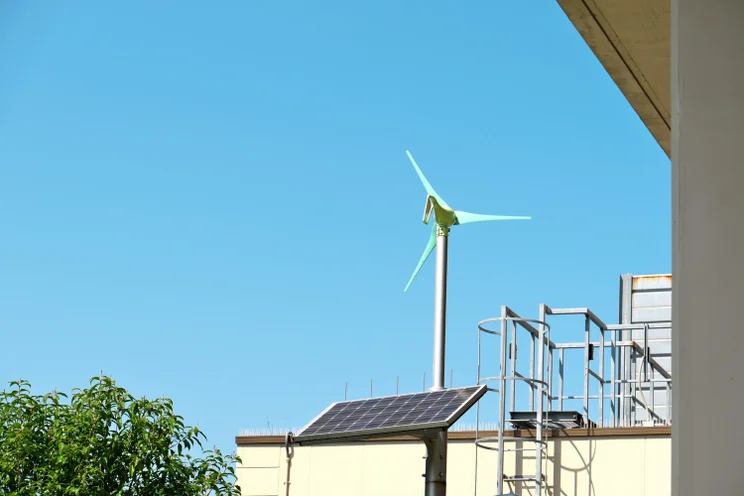
Planning permission is no longer required for small wind turbines in the UK as the government looks for ways to cut energy bills.
Commercial properties including businesses, schools, and farms could install a turbine up to 30 metres tall, which is about the same size of a mature oak tree, without needing to get permission. the need for a planning application.
Right now onshore wind developments, which includes domestic turbines, fall under something called ‘limited permitted development rights’, which has strict height and size limits.
The changes have come because the government needs to bring down energy bills, particularly since the beginning of the US-Iran war, which has made costs balloon.
Michael Shanks, energy minister, said it would help businesses, schools, and farmers the tools to “lower their bills and make the best use of their land.”
UK smashes wind record
The ripping up of planning permission has come after the UK set a new wind energy record. According to the National Energy System Operator (NESO), the UK’s wind farms generated 23,880 megawatts (MW), smashing the previous record of 23,825 MW, set on 5th December 2025.
Tara Singh, Chief Executive at RenewableUK, said “global instability” shows how important it is to “build out an ambitious pipeline of new clean energy projects now and in the years ahead.”
“Wind provided more than half of Britain’s electricity during this record period,” Singh said, claiming that wind and solar “squeezed expensive gas off our energy system,” with gas falling to its lowest level of generation for nearly two years, providing just 2.3% of our electricity.
Onshore wind is recognized as one of the fastest and most economical energy sources to deploy. However, existing planning regulations and the associated high costs have often prevented otherwise acceptable small wind turbine projects from going ahead, even when they are financially viable, according to the Department for Energy Security and Net Zero (DESNZ).
The department is now set to expand permitted development rights for onshore wind to include non-domestic locations.The proposed measure would offer protection against volatile fossil fuel markets, which drive up energy costs.
At the same time, strong safeguards for both landscapes and communities would be maintained. Turbines won’t be allowed to be built in areas such as conservation zones, national parks, sensitive habitats, heritage sites, and land associated with listed buildings.
Additionally, measures to protect neighboring properties, such as establishing a buffer zone between any installed turbine and the property edge, may be included.
Shanks continued: “By allowing farmers, schools and businesses to build a single small onshore wind turbine – no larger than an oak tree – without planning permission, we are giving them the tools to lower their bills and make the best use of their land.
“In the midst of uncertain global markets, the only way for households and businesses to have certainty is to invest in clean homegrown power such as onshore wind, one of the cheapest and quickest forms of energy to build.”
The Eco Experts’ view: are wind turbines the answer to high energy bills?
Wind is a free, infinite source, protecting consumers from fossil fuel price volatility, which makes wind turbines vital for long-term energy cost reduction. We think that wind turbines are the answer to high energy bills, but not alone.
In order to lower energy bills for your home or commercial property as much as possible, we would suggest coupling a wind turbine with a solar panel system to keep generating electricity for you when there’s less wind, and a storage battery to store surplus energy for later.
Currently, grid limitations are a major hurdle to using wind energy. If wind turbines aren’t local to your property, current infrastructure will struggle to move power. While wind generation costs are falling, transmission and reliable 24/7 backup expenses prevent consumer prices from dropping faster.
Wind energy offers a shift away from global fuel markets, creating a more stable, domestic energy supply less vulnerable to international conflicts or shortages. Our opinion of wind turbines is that they build a future with more affordable, predictable, and sustainable energy. Combined with other clean technology, such as solar panels and heat pumps, they are a great way to bring down bills.