


We may receive a fee from trusted installers when you request a quote, or a commission when you buy through links on our site. This helps us keep our content independent, well-researched and up to date – Learn more
- PwC has also projected a £94.3bn lunar economy by 2050
- The Luna Ring concept is a solar belt built around the moon’s equator
- Solar panels could be created using moon dust
- Any long-term settlement to also need nuclear and huge storage
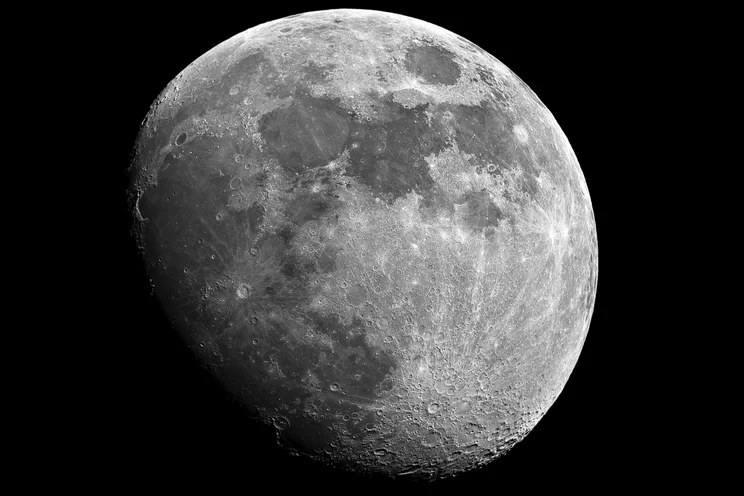
Solar energy could one day be helping to power a £94.3bn economy on the Moon, according to accounting giant PwC.
In its ‘Lunar market assessment’ report the company predicted that while by 2050 there could be a flourishing human presence on the Earth’s nearest satellite, getting started will depend on energy infrastructure.
Building the right infrastructure will be incredibly important because solar is likely to be the main energy source of any settlement on the Moon because it is “lightweight” and “easily deployable”, according to PwC.
This will require new types of solar technology, and researchers and companies are looking for ways to make sure solar energy can power a civilisation on the Moon.
Japanese construction company Shimizu Corporation has put forward a plan for the Luna Ring concept—a belt of solar cells built by robots around the moon’s 6,800 mile equator, able to convert electricity into powerful microwaves to be beamed at the Earth and converted back into electricity at terrestrial power stations.
The Luna Ring would initially have a width of a few kilometers, but could be potentially extended up to 400km, and would allegedly achieve 24/7 continuous clean energy generation.
Scientists from the University of Potsdam have found a way of making solar panels using moon dust. Solar cells are essential for space exploration, but are often too weighty to get them into space. Roughly 50% of moon dust is made of silica particles, which is the main ingredient used for making glass, making it a good candidate to substitute Earth-made glass.
Felix Lang from the University of Potsdam, who led the development of the new solar panels, said: “Every kilogram you launch into space is expensive. If we can make solar panels on the Moon, we can cut that weight by 99%.”
The Eco Experts view: will solar power be enough?
No, because while it may help power a human civilisation at the beginning, it is unlikely to be a long term fix on its own. In its report, PwC said that NASA doesn’t believe solar energy will be enough to sustain human civilisation on the Moon, especially at night.
A normal night on the Moon lasts two weeks on Earth, and at that point solar panels would stop generating power and leave anyone there relying on batteries and storage. Another thing is that nighttime temperatures on the Moon fall below –170°C, requiring additional energy for heating.
Instead, the future booming Lunar economy will need a lot of lithium-ion batteries and regenerative fuel cells (RFCs), which can be used to store energy while none is being generated.
Any Lunar future will also depend on nuclear energy, with PwC saying small reactors, that is fission-based systems that supply continuous, stable power when there is no solar power will be “essential for operations”, especially during the two-week night and the parts of the Moon that are permanently in shadow.
Mihails Ščepanskis, CEO, Deep Space Energy, a company that builds radioisotope power systems, emphasizes that solar power will not be an ultimate solution.
“We already learned the lessons here on Earth that power needs can’t be an afterthought, or there will be a price to pay, especially when we discuss resource exploration missions, commercial operations, or permanent systems on the lunar surface.
“Reliable surface energy is still one of the biggest gaps on the Moon.”
Ščepanskis explained that “because of the long nights, any long-term operation on the Moon must have “reliable solarless power generation to survive lunar night without blowing up the budget.”
“Solar will remain crucial for daytime operations, nuclear reactors will serve stationary bases, and compact non-solar systems will enable mobility,” Ščepanskis concluded. “We need all of that for sustainable Moon operations.”
To meet these challenges and to make sure the Moon has the best chance of housing a human civilisation, PwC said NASA is currently developing a Lunar ‘microgrid’ designed to flexibly integrate multiple sources, including solar power, small nuclear reactors, RFCs, and lithium-ion batteries.
NASA is also planning to begin crewed missions to the Moon’s surface by 2028.
What happens next?
In April 2026, NASA launched Artemis II as part of a bid to return humans to the Moon by 2028. The flight is a mission to collect data on radiation exposure and how the body reacts when beyond low-Earth orbit. It won’t specifically test solar energy’s potential to power a human civilisation on the Moon, but it is a big step towards doing so, and solar energy will undoubtedly help.


