


We may receive a fee from trusted installers when you request a quote, or a commission when you buy through links on our site. This helps us keep our content independent, well-researched and up to date – Learn more
- Allume Energy spoke exclusively to me about SolShare 2
- The technology allows several flats to be connected at once to generate electricity
- It’s a world first for low-income households
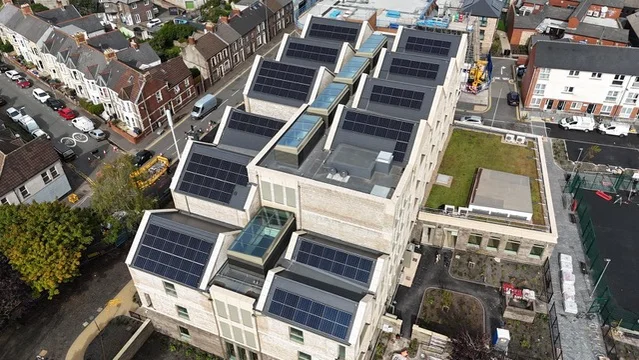
It’s long been assumed that flats aren’t suitable for solar panels, with the shared roof top space being too small for occupants to really enjoy the benefits of cheap and clean energy.
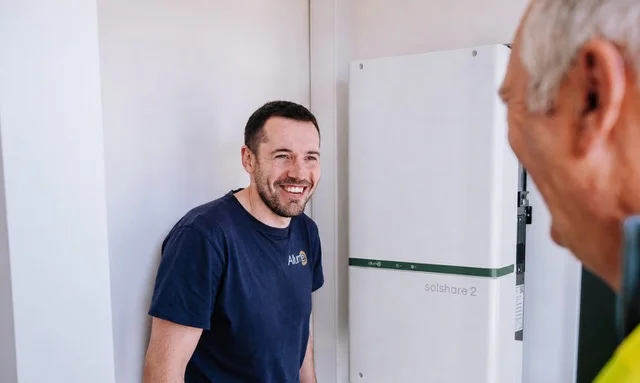
Allume Energy UK think they’ve solved it and built SolShare 2, currently the only technology in the world that can connect multiple separately metered flats to a single rooftop solar array and community battery.
Allume Energy has enjoyed enormous growth on home turf in Australia and is now looking to break into the UK market. The company sees huge potential for growth, particularly by making solar power accessible to those who might not have thought they had the space for a solar panel.
Allume’s latest innovation covers a lot of obstacles that might have previously stopped anyone in a flat from making the most out of solar power, including space and flexibility of use. SolShare 2 allows for:
- Maximum Flat Connections: Connects up to 15 single-phase flats (or 5 three-phase connections) per single SolShare unit. If a building has more flats, multiple units can be linked together.
- System Capacity: Handles up to 30kW of solar power capacity, which is a 50% increase compared to the first-generation SolShare model.
- Switching Speed: Adjusts and re-routes power every 200 milliseconds (0.2 seconds) to match whichever flat is using electricity at that exact moment.
- Physical Size: Features a 25% smaller footprint than the older version, making it easier to fit into tight utility or plant rooms.
- Battery Compatibility: Integrates smoothly with DC-coupled community battery storage over an Ethernet link so power can be saved during the day and used at night.
- Internet Connection: Uses a dedicated 4G connection for remote monitoring, software updates, and tracking energy splits.
- No Access Needed Inside Flats: Installs entirely in a central plant room or main switchboard, meaning no equipment or wiring changes are required inside individual apartments.
- Utility & Panel Freedom: Works with any brand of solar panels and does not force residents to change their current electricity supplier.
- Weatherproof Rating: Built with an IP56 weather and dust resistance rating for safe placement in communal utility areas
How does SolShare 2 help people who live in flats and social housing?
People who live in social housing can cut their energy bills by as much as 70% and help developers improve the energy efficiency of their buildings, thanks to solar panels and batteries. The challenge is still making people, tenants and developers, aware of how they can bring down bills and improve home energy efficiency.
Speaking to The Eco Experts, Jack Taylor, General Manager – Europe at Allume Energy, who recently launched SolShare 2, its latest solar and battery offering for flats, said that one biggest barrier to the market is still that people aren’t aware that there are solar tools for people who live in flats.
This is despite the huge advantages that people who live in flats and developers, in particular social housing, have to gain by installing solar panels and batteries.
Taylor was speaking to us after Allume Energy launched SolShare2, a shared solar technology that cuts energy bills, improves home efficiency and helps low-income families escape fuel poverty.
SolShare 2 works by allowing several flats to access solar energy by connecting to one rooftop panel array. It allows energy to be split among all the different participants. This cuts how much energy they’re using from the grid and brings down their monthly bills.
In one particular case study, occupants of 24 flats in Cardiff were able to save £690 a year on average with bills falling by 70%.
It is particularly good for low-income families and those in social housing because the storage element of the system allows for when solar panels are not generating enough. The challenge can be simply spreading the word.
“Since we first launched in the UK, one of the biggest barriers is that people don’t know that the solution exists,” Taylor explained.
“We are constantly trying to get people to realise when they’re looking at their buildings it is possible to fit their roof with solar PV and connect the different flats together.”
“But what we’re trying to do is we’re trying to figure out how we can provide the appropriate options for the apartment building whatever it happens to be.
“A social housing project may want this solution, whereas a private block of flats may want something slightly different, so we’re constantly thinking about what works for different projects.”
How much of a challenge is to get solar panels on flats?
Getting people who live in flats to install solar panel systems is a challenge, and the numbers show how steep the challenge is. According to Energy Savings Trust, just 3% of people in the UK who live in flats have solar panels installed. On top of that, blocks of flats account for just 11% of all solar panel installations in the UK.
When you take into account that approximately nine million people in the UK live in flats, which is roughly 14% of the population, this is a hugely underutilised area.
How does the government help enough of the nine million people who live in flats to get bills down?
The Future Homes Standard, which is due to come into force on 27th March 2027, will make all new builds include rooftop solar PV coverage equivalent to 40% of the dwelling’s ground-floor area.
That’s great for people moving into newly built blocks, but there is still a need for something that helps people living in older buildings, especially lower-income households.
There’s also an issue of energy flexibility, using energy when you need it most and when it’s cheaper than at peak times (some industry experts have called energy flexibility one of Britain’s great underutilised bill-cutting tools).
That’s where Allume believes the SolShare 2 could massively help because of the “tailorability” of the product.
As well as connecting different properties to the same system, it can assign generated or stored solar capacity to specific and individual flats depending on need. It takes this information from individual smart meters, checking the electricity usage of each flat every 200 milliseconds.
This is called the ‘switching speed’. By doing this it also allows surplus energy to be sold back to the grid through the Smart Export Guarantee.
There’s no doubt that SolShare 2 could potentially unlock solar power for a lot of people, possibly nine million or more, and there is nothing on the market like it right now, but that awareness is such a challenge shows that the government needs to do more to get the message out there. Namely that living in a flat or social housing needn’t hold anyone back when using solar power.
What will it do? The winding down of ECO4 will leave a massive gap in energy efficiency support for low-income households. Will the Warm Homes Plan fill that? And what role will shared community technology and projects play?
Community clean power is something Andy Burnham supported as Mayor of Greater Manchester, perhaps he should look at SolShare 2 as a way of replicating that nationwide.


