We may receive a fee from trusted installers when you request a quote, or a commission when you buy through links on our site. This helps us keep our content independent, well-researched and up to date – Learn more
- Tesla will begin winding production of its iconic Cybertruck next year
- The company will instead focus on Cybercabs
- It recently announced that it’s integrating compatible heat pumps into its Powerwall 3 battery
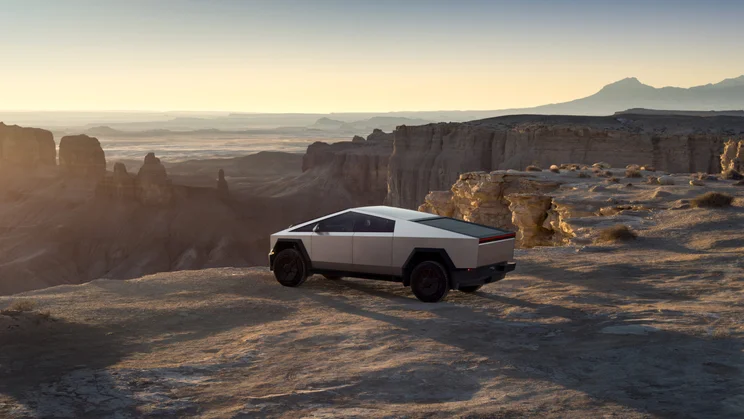
Tesla will no longer manufacture its iconic Cybertruck following plunging sales and will instead focus on Cybertrucks and storage batteries.
Tesla’s CEO Elon Musk, the world’s richest person, said in a post on X, formerly Twitter, which he also owns, that the company would be “winding down production” of the Cybertruck at its factory in Austin Texas in the middle of the 2027.
The company, the second biggest manufacturer of electric vehicles (EVs) in the world after BYD, will do this to “make room for Cybercab production”, according to Musk.
Tesla will “try to make as many as possible before shutting down”, but the company will have to “return deposits for a lot of people”, Musk said.
The move means that UK customers will never get the chance to own or drive a Cybertruck as they were never legal over here. Cybertrucks were banned in the UK for not meeting safety laws. Essentially, the Cybertruck was too big and heavy (by about 500kg) to be driven on UK or EU roads.
The Cybetruck weighs an estimated 4,000kg, regulations to drive in the UK limit a car’s weight to 3,500kg.
What are Tesla Cybercabs?
The Tesla Cybercab is an autonomous EV taxi that is designed for commercial taxi use. The company unveiled it in October 2024 and launched its first public, paid-for rides in September 2026 in Austin, Texas.
In moving away from the Cybertrucks and towards Cybercabs, Tesla is putting aside the big, high profile products in favour of what is arguably a more sensible commercial strategy. Each driverless, two-seater Cybercab will cost between £15,000 and £21,000 to make, as opposed to the £45,000 or so it cost to build just one Cybertruck.
Will Tesla Cybercabs be available in the UK?
Maybe. We don’t know yet because Tesla hasn’t announced a timeline of when Cybercabs might be available to use in the UK.
Is Tesla focusing on energy?
Yes, Tesla is very much focusing on energy, particularly residential storage. Last week it announced that its Powerwall 3 battery would be fully integrated into compliant heat pumps through Heat Pump Optimisiation.
Long term, the company wants its customers as part of a closed-loop system that involves its own solar panels, batteries, and EV chargers, independent of the national grid.