We may receive a fee from trusted installers when you request a quote, or a commission when you buy through links on our site. This helps us keep our content independent, well-researched and up to date – Learn more
- How does the wholesale price of gas affect energy bills?
- Natural gas to the rescue
- But isn't that a crazy system?
- How much of my energy bill is for the actual energy?
- Has the US-Iran war made gas more expensive?
- What is the wholesale price of gas right now?
- What can I do to protect myself from the wholesale price of gas?
- Summary
- Electricity prices are set by the most expensive power plant needed to meet demand (often gas)
- Even small changes in gas supply or price can ripple through the entire electricity market
- Household energy bills also include network costs, policy levies, taxes, and supplier costs

Energy bills are hugely affected by the price of wholesale gas, with even the cost of electricity rising and falling with it. This is largely due to how electricity markets set prices and the fact that electricity is generated by gas-powered stations.
Understanding this system helps explain why geopolitical events and gas shortages can quickly affect what households pay for power. We’ve taken a look at why energy bills, including electricity, are so heavily linked to the price of gas.
How does the wholesale price of gas affect energy bills?
It’s estimated that about 40% of your energy bill is set by the price of wholesale gas. Energy bills across Europe, including the United Kingdom, are driven by something called a merit order system. In simple terms, this is a kind of auction where different power plants bid to supply a national grid.
Under this system, bids are sorted from lowest to highest until the total demand for a country’s power consumption is met. With this system, the final power plant needed (renewable, coal, nuclear, gas, hydro, etc.) sets the overall price per kWh for all bidders.
You can liken this to filling a series of buckets to meet a total volume of 5 buckets needed for a day’s consumption. The first bucket might be filled with energy from things like solar or wind, with the second and third then filled with hydro and say nuclear.
A fourth bucket could be filled with coal, and a fifth with gas. Each bucket is filled in order until the last bucket (gas) is filled to meet the total day’s bucket demand. It is the cost of the final bucket that sets the overall price, in this case, gas.
In reality, the system is a little more complex. Energy suppliers typically buy electricity and gas on wholesale markets months or even years in advance through so-called “futures” contracts, which lock in a price ahead of time before that energy is sold on to households and businesses.
Natural gas to the rescue
For most nations in Europe, this final “topping up” power source is usually natural gas. So, even if gas-fired power plants only supply a few percent of the total, they will set what is called the “clearing price” for all suppliers through daily wholesale auctions.
This is not random, as gas-powered power plants are particularly useful for topping up demand. They are quick to fire up and are very flexible for energy demand, especially during demand spikes.
The UK, in particular, is very sensitive to changes in wholesale prices of gas as it supplies between 35% and 46% of annual electrical production. It also has a very poor stockpile capacity, which can be used to “smooth out” supply issues.
For this reason, it is usually the main driver of energy costs day-to-day. So, if wholesale gas prices spike (like during a geopolitical crisis), electricity prices will usually spike too. When prices fall, electricity prices will also fall in response (albeit slowly).
But isn’t that a crazy system?
On the surface, this kind of auction system can seem a little strange. Why should consumers pay the highest price when much of the electricity is produced far more cheaply?
In short, the system exists to encourage investment. Building power infrastructure, especially nuclear plants, offshore wind farms, and other large-scale generation, requires enormous upfront costs. If generators were only paid their operating costs, many projects would never recover their construction costs, and investors would simply stop building them.
The current system allows cheaper generators to earn additional revenue when prices are set by more expensive plants. That extra margin helps justify the massive upfront investment required to build new capacity.
It also encourages suppliers to produce electricity as efficiently as possible. The larger the gap between the market price and their operating costs, the more profit they can earn.
In theory, if enough cheap and reliable energy sources are built (particularly renewables and storage), the system will need gas plants less often. When that happens, the overall market price should fall because cheaper generators will increasingly set the price.
The design also keeps the market relatively simple to operate. Paying all generators the same “clearing price” makes settlement easier and reduces regulatory complexity.
Finally, it discourages strategic bidding. If generators were paid exactly what they bid, they would likely inflate their bids close to what they expected the market price to be.
For example, a wind farm that could produce electricity for £5 per unit might still bid £79 if it knew gas plants would push the price to £80. In practice, consumers would end up paying roughly the same price anyway.
How much of my energy bill is for the actual energy?
In theory, if enough cheap and reliable energy sources are built (particularly renewables and storage), the system will need gas plants less often. When that happens, the overall market price should fall because cheaper generators will increasingly set the price.
The design also keeps the market relatively simple to operate. Paying all generators the same “clearing price” makes settlement easier and reduces regulatory complexity.
Finally, it discourages strategic bidding. If generators were paid exactly what they bid, they would likely inflate their bids close to what they expected the market price to be.
For example, a wind farm that could produce electricity for £5 per unit might still bid £79 if it knew gas plants would push the price to £80. In practice, consumers would end up paying roughly the same price anyway.
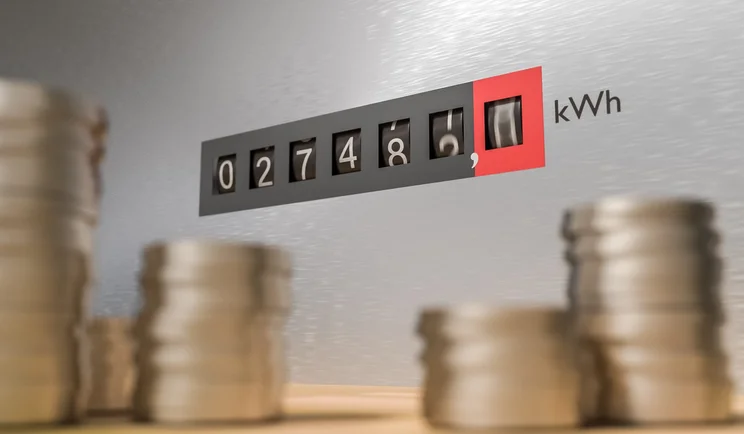
Another 5% goes towards taxes like Value Added Tax (VAT). It is important to note that these costs are split between the cost you pay per kWh and a standing charge (daily fee). The latter covers, primarily, the fixed costs to a supplier, with the former covering the wholesale cost of fuel, levies, and some of the network costs.
That leaves around 2-4% as actual profit for the supplier, a very slim margin indeed. So, in real terms, assuming an annual bill of around £1,700 that you pay, only around £700, or so, pays for the actual energy you use.
Has the US-Iran war made gas more expensive?
Yes, without question, the US-Iran war has pushed up the price of gas, and this will make energy bills more expensive. As you can see from the previous section, it should become abundantly clear why any shock to the gas wholesale price can dramatically impact your monthly energy bills.
Like any raw material in the world, if its supply suddenly drops, the price per unit of it will necessarily rise. That’s as true for natural gas as it would be for things like gold, oranges, cars, or consumer electronics.
It’s expected that energy bills may increase by as much as 10% because of the US-Iran war, in particular, the chaos around the Strait of Hormuz. Around 20% of the world’s crude oil and between 20% and 25% liquefied natural gas (LNG) travels through the Strait of Hormuz. Anything that gets in the way of this supply means that a quarter of the world’s gas is stopped and doesn’t get to where it needs to be.
The UK imports 8.03 megatonnes (MT) of LNG a year, and in 2024, natural gas accounted for 35% of the country’s energy consumption as a whole.
According to sources such as NPR, global export traffic through the region has been severely affected by the conflict. Iran, for its part, has declared the strait effectively closed and has been resorting to attacking any ships attempting to navigate the waterway.
In response, global prices for things like crude oil and gas shot up by over 10% or more. UK wholesale prices, however, effectively doubled.
But that is only part of the problem. Actual production facilities are also being actively targeted by Iran’s Islamic Republican Guard Corps (IRGC) in neighbouring countries like Saudi Arabia, Qatar, and the UAE.
If that wasn’t enough, shipping companies are also having to deal with insurance-driven shutdowns. In other words, underwriters are currently not willing to take the risk of insuring ships and companies willing to risk operating in the region.
This double-, well triple-whammy, is not only restricting exports, but also raises questions about the physical extraction capability of these supplier nations over the next few months.
What is the wholesale price of gas right now?
At the time of writing, natural gas in the UK is currently sitting at around 129 pence per therm. That is around 56 pence/therm higher (about a 76% rise) than it was before the outbreak of the US-Iran conflict.
In case you are unaware, a therm (usually expressed as thm) is a standard unit of heat energy equal to around 100,000 British Thermal Units (BTU). This equates to around 105 megajoules (MJ) or 29.3 kilowatt-hours (kWh).
One therm is roughly the energy contained in about 100 cubic feet of natural gas at room conditions.
To put that into perspective, prices have reached similar levels over the past 5 years, with two notable peaks in mid-January 2025 and October 2023. Excluding the massive changes in price in the early years of the Russia-Ukraine War (where prices peaked at 640 p/therm in August 2022), prices have hovered around 90p/therm for most of that time.
The 2023 and 2025 spikes were a consequence of restricted supply (gas supplies were interrupted via Ukraine) and increased demand for gas due to drops in sunshine levels and wind speeds (e.g, the 2025 Dunkelflaute).
What can I do to protect myself from the wholesale price of gas?
While wholesale gas prices and market design are largely outside the control of consumers, there are several practical steps households can take to reduce their energy bills and become more energy independent over time.
Some measures provide quick savings, while others require upfront investment but can significantly reduce long-term energy costs.
Improve insulation first
The cheapest energy is the energy you don’t need to use. Therefore, improving your home’s insulation can dramatically reduce heating demand.
Some common insulation measures include:
- Loft insulation – which can prevent up to 25% of heat loss through the roof
- Cavity wall insulation – reducing heat escaping through external walls
- Draught-proofing doors and windows – which is inexpensive but effective
- Double or triple glazing – which reduces heat loss and improves comfort
These upgrades often pay for themselves relatively quickly through lower heating bills.
Install solar panels
Solar panels allow households to generate their own electricity. While installation costs can be high, they can reduce reliance on grid electricity and protect households from rising energy prices.
In the UK, a typical rooftop solar system can generate 30–60% of a household’s annual electricity needs, depending on roof orientation and local weather conditions.
Any excess electricity can often be sold back to the grid through schemes such as the Smart Export Guarantee.

Add battery storage
Home batteries store electricity generated by solar panels during the day for use later in the evening when demand is higher.
They can also be used with time-of-use tariffs, allowing households to store cheap overnight electricity and use it during expensive peak periods.
While batteries add upfront cost, they increase the value of solar generation and further reduce grid reliance.
Switch to smarter tariffs and appliances
Even without major upgrades, households can reduce bills by:
- Changing older bulbs (tungsten bulbs and spotlights) with energy-saving lightbulbs (LEDs or CFLs)
- Installing smart thermostats to better control heating
- Signing up for cheap fixed tariffs or switching to time-of-use tariffs, which offer cheaper electricity overnight
- Running appliances such as washing machines and dishwashers during cheaper periods can also save a pretty penny
Summary
- Gas still drives electricity prices across much of Europe because gas-fired power plants often set the marginal price in wholesale energy markets.
- Geopolitical events can quickly affect bills, as disruptions to global gas supply rapidly push wholesale prices higher.
- The UK is particularly exposed due to its reliance on gas imports and relatively limited storage capacity.
- Wholesale energy costs make up only part of a household bill, with network charges, policy levies, operating costs, and taxes making up the rest.
- Improving home efficiency through insulation, glazing, and smarter energy use can reduce bills quickly and cheaply.
- Investments in solar panels and battery storage can help households generate and manage their own energy, reducing exposure to volatile energy markets over time.