


We may receive a fee from trusted installers when you request a quote, or a commission when you buy through links on our site. This helps us keep our content independent, well-researched and up to date – Learn more
- Scientists in China tested panels at 10 metres deep in the South China Sea
- Results show that there is a huge potential to power machines in remote marine areas
- Researchers will now test solar panels at deeper depths
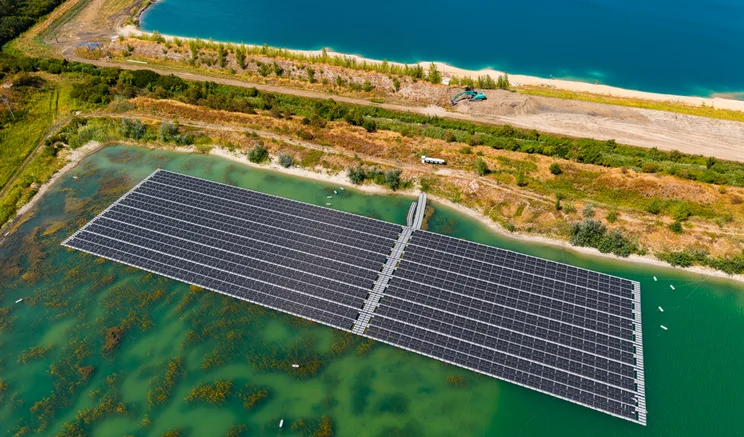
The answer is yes, solar panels can work under water and be used to generate cheap and clean electricity, according to researchers from China and Switzerland.
Scientists from the Yunnan University tested solar panels 10 metres below the surface of the South China Sea and generated 324 megawatt-hours of energy in two hours, enough to charge lithium-ion batteries.
What does this mean in reality? The scientists say there’s huge potential to power underwater sensors, cameras, and most importantly, industrial communication systems far away from land.
Underwater solar energy isn’t a completely new idea, it’s been held back because of sunlight drops in intensity very quickly once it goes below the surface.
How did the scientists make the solar panels work 10 metres under water? By creating a “customised laboratory system” with in-built “tailored optical filters” that simulated “underwater illumination at various depths”.
How did the underwater solar panel tests work?
During the tests, the researchers found that the underwater solar panels worked best with wide bandgaps, which absorbs blue to orange light. After storing the cells in a glovebox filled with nitrogen gas for 300 days, the solar cells retained about 96% of their initial efficiency.
On top of that, the solar cells showed “no degradation” after 1,160 hours at a depth of 10 metres which suggests “exceptional durability underwater”.
The next phase of the tests involved underwater robots, powered by the submerged solar panels. The team said the panels showed “exceptional long term operational stability”.
Wen-Hua Zhang of Yunnan University and Southwest United Graduate School in Kunming, lead researcher and author of the paper, said they were surprised by how much electricity the panels generated at such depths.
Zhang also said that the tests provide “strong evidence for the operation of underwater photovoltaics”.
How deep can underwater solar panels go?
That’s a great question, and the answer is we don’t know at this stage. However, Zhang says his team is planning to test solar panels at deeper water depths to see just how far down sunlight can be captured to generate cheap and clean electricity.
Maybe one day we’ll be exploring the Mariana Trench with solar batteries one day soon.


