We receive a small fee from trusted installers when you request a quote through our site. This helps us keep our content independent, well-researched and up to date – Learn more
- The new wind turbine will have an output capacity of 26 megawatts
- Based in Fujian province, it will have a swept area of 75,477 m2
- It will produce 100 million kWh of electricity a year
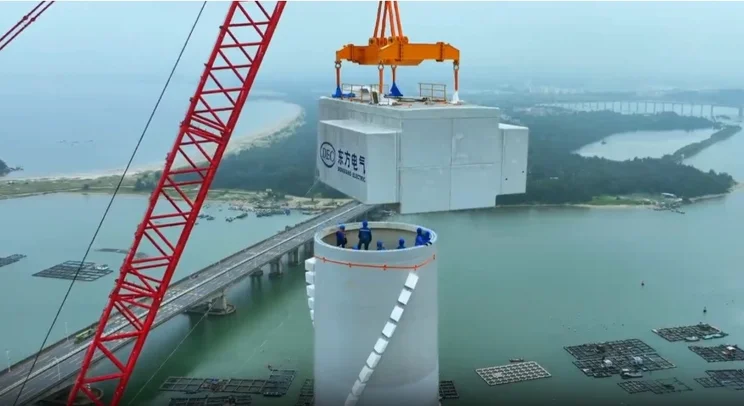
Chinese energy firm Dongfang Electric Corporation (DEC) has commissioned the world’s largest single-capacity offshore wind turbine to be installed in Fujian province.
Rolled off the production line in November 2024 at the Fujian Fuzhou Offshore Wind Power Industrial Park, this monster turbine has, by all accounts, an output of up to 26 megawatts (MW), beating the previous Chinese record holder, the MingYang Smart Energy MySE 16.0-260, by 6 MW.
Designed for offshore use, it will be big enough to produce half the output of large wind farms, such as Norwegian Offshore Wind Catching Systems, with its planned 40 MW output.
With a wind rotor diameter of 310 meters (1,017 feet), the turbine has a swept area of 75,477 m2 (812,424 square feet).
To put that into perspective, it is bigger than the entire floor of the United States Capitol Building, at 67,000 m2, or about the same area as 11 football pitches. The rest of the turbine is also humongous, with its height (340 meters or 1,115 feet) exceeding that of the Eiffel Tower or the Chrysler Building.
The turbine reportedly has “advanced anti-corrosion” technology, being fully sealed to stop salt spray corrosion. It also comprises over 30,000 components and has dual internal and external cooling systems.
According to Offshore Wind, the turbine also features third-generation fully integrated semi-direct drive technology that combines the shaft system, gearbox, and generator.
This also makes it taller than a U.S. Gerald R. Ford-class Supercarrier is long. According to DEC, the turbine will also be built tough enough to resist typhoons and corrosion at sea; in fact, “it can withstand a Category 17 super typhoon,” DEC explains.
That means in practice it can reportedly withstand wind speeds of up to 137 mph (220 km/h), which is about the same as a Category 4 hurricane. For reference, according to UNICEF, these are “extremely destructive power, sinking large ships, potentially causing severe damage and serious flooding.”
Initially believed to be destined for the Fujian offshore wind farm in the Taiwan Strait, the turbine was installed at the Dongying, Shandong, China, test facility in late 2025. Assuming average wind speeds of around 22 mph (36 km/h), it should be capable of churning out 100 GWh of electricity every year.
This translates into around 100 million kWh of electricity year-in-year-out. That’s enough power, according to New Atlas, to keep the lights on for some 55,000 Chinese households annually.
The new turbine now knocks the previous record-breaker, Mingyang’s 20-MW, out of the top spot. According to Mingyang, that wind turbine was designed to comfortably weather level-17 typhoons with wind speeds in excess of 79.8 m/s (178.5 mph).
This new turbine now pushes China’s total installed wind capacity to well over 470 GW, which is more than triple that of its peers, like the USA.
Wind turbines of this scale are indeed ambitious, but they also make sense long-term. Wind is often more reliable offshore, meaning that wind turbines (whether large single units or large farms) can more predictably generate power throughout the year.
Installation offshore also prevents the loss of valuable land, and can make more economic sense as larger turbines, like this one, are relatively easier to transport by ship than by vehicle on land.
Elevated installation costs aside at sea, given the more complicated engineering involved, and once installed, offshore wind turbines can generate more power than land-based ones. This, in theory, makes the increased cost of installation pay off faster.
A recent International Renewable Energy Agency report confirms this is already underway. According to the report, the global weighted average Levelized Cost of Energy (LCoE) of offshore wind dropped from about twice that of fossil fuels in 2010 to just 17% in 2022.
The report also notes that while offshore wind still has a higher LCoE than other renewables (like solar and hydro), it has the potential to make it viable for more investment globally.