We may receive a fee from trusted installers when you request a quote, or a commission when you buy through links on our site. This helps us keep our content independent, well-researched and up to date – Learn more
- AR7 is the biggest successful offshore wind energy auction in European history
- The energy generated is enough to power 12 million homes
- Offshore wind is taking up an increasingly bigger proportion of UK energy
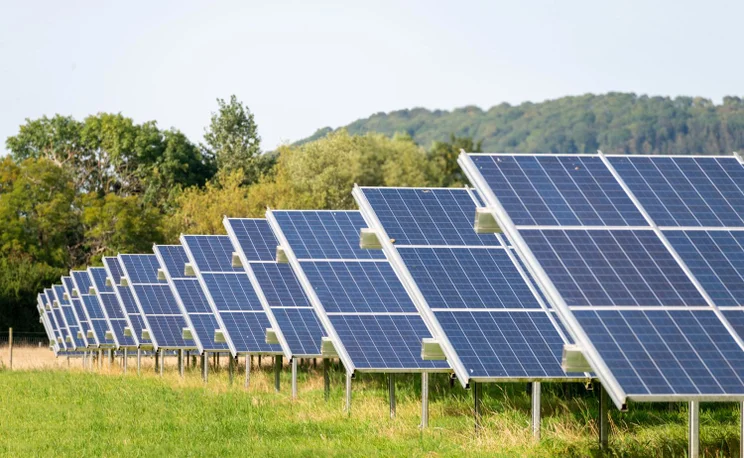
Britain has taken what the government has called a “significant step” towards lowering bills and ending its reliance on fossil fuels after it secured a record-breaking 157 solar projects in the latest Contracts for Difference auction.
The projects secured as part of Contracts for Difference AR7 adds 4.9 gigawatts (GW) to the UK’s clean energy capacity. This is on top of 8.4GW of offshore wind energy also secured during AR7.
All in all, the auction produced 14.7 million GW of new clean power, enough to power 16 million homes.
It was revealed in January that the AR7 auction had produced the single-biggest government-backed procurement of offshore wind ever seen in Europe.
Secretary of state for energy and net zero Ed Miliband described it as “a historic win” for those who want Britain to control its own energy instead of being dependent on “markets controlled by petrostates and dictators”.
Miliband claimed that by backing solar and onshore wind at scale, the government was “driving down bills for good”.
“Clean, homegrown power is the right choice for this country to bring down bills for good,” Miliband explained, claiming that the auction will also “create thousands of jobs”.
AR7 auction facts
Solar:
- Capacity secured: 4.9GW
- Number of projects: 157
Onshore wind
- Capacity secured: 1.3GW
- Number of projects: 28
Tidal
- Capacity secured: 20.9MW
- Number of projects: 28
Offshore wind (fixed and floating)
- Capacity secured: 8.4GW
- Number of projects: 12
Projects have won in every part of the United Kingdom – including fixed offshore wind in:
- Dogger Bank South off the coast of Yorkshire and Norfolk Vanguard off East Anglia – two of the largest offshore wind farms in the world, supporting thousands of jobs
- Berwick Bank in the North Sea – the first new Scottish project since 2022 and the largest planned offshore wind project in the world
- Awel Y Môr – the first Welsh project to win a contract in more than a decade
In a statement, the government said the results show that offshore wind, alongside solar and onshore wind remain “cheaper to build and operate than gas generation”.
How will the AR7 auction bring down energy bills?
The AR7 auction will bring down energy bills as it generates more clean, renewable energy and make the households less reliant on fossil fuels, which are vulnerable to severe price spikes.
The more clean energy Britain produces, the cheaper it will become. Wind power in particular is helping to bring down energy costs as it is reducing the amount of time that gas power stations set the overall price of electricity on the wholesale market.
Research from the Energy and Climate Intelligence Unit (ECIU) last October found that gas is only setting the price 85% of the time, having previously done so 100% of the time. This has led to a drop in the wholesale price of electricity by up to 25%.
By being less reliant on gas, household bills are less likely to increase suddenly when international crises disrupt supply, such as the war in Ukraine or conflict in the Middle East.
How does an auction work?
Auctions such as this take place every year, and renewable developers submit bids to secure Contracts for Difference (CfD) to support their project. Having a CfD means renewable energy generators have a set price (called a ‘strike price) for electricity, which protects households and businesses from volatile prices, which are set by gas.
If the strike price gives developers the confidence they need to invest long term because they are guaranteed a set price for the power they generate, which in turn lowers finance costs, which means less cost gets passed on to consumers.
If the wholesale price of electricity rises above the strike price, developers pay consumers the difference.
The strike price for offshore wind of AR7 was £91/MWh, which is higher than the previous round of £80MWh but far lower than the £147/MWh it would have cost to build a new gas station.
Research from Aurora Energy Research and Baringa Consulting have found that anything below £94/MWh should mean a direct cut in energy bills.
How has the clean energy industry reacted to AR7?
The response to AR7 has been overwhelmingly positive. GregJackson, CEO and founder, Octopus Energy, the largest energy supplier in the UK, said the projects will “add significantly more wind to the grid” and urged the government to “urgently reassess all infrastructure plans and assumptions” and “reform the electricity market to reduce wasted wind”.
Dhara Vyas, CEO, Energy UK, said the auction results will “deliver critical national infrastructure” that will “deliver lower bills” and provide “economic growth across Great Britain”.
Ana Musat, executive director of policy, RenewableUK described AR7 as “a great result for Britain energy security and for hard-pressed billpayers” predicting that the new offshore wind farms will generate the “power we need at lower cost than new gas or nuclear plants” at a “stable and predictable price”.
Sam Hollister, head of UK market strategy, LCP Delta, had said the government had moved from a “cautious jog to a confident sprint” to clean power and that the UK’s renewable sector had the confidence of investors.
“We have broken the back of the 2030 target, and with continued momentum, that now looks achievable for the first time in a long time,” Hollister said.
“The challenge now is no longer about ‘catching up’—it is about maintaining this momentum to build a resilient, decarbonised energy system for 2050.”